“My care team always encouraged me. They were so positive. I really felt cared for.”
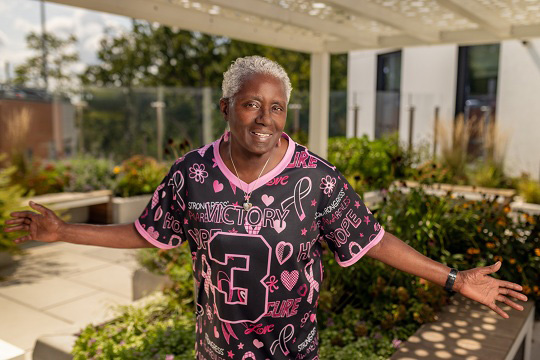
For years, caring for others came naturally to Mary Hinton. As a daughter, sister and beloved high school custodian, she was accustomed to putting the people she loved first.
When her mother became seriously ill, Mary and her sister worked together to care for her, as being there for her became their priority. During those years, Mary sensed that something was not right with her own health. But with her attention focused on her mother, she pushed those concerns aside. “You just keep going because that’s what you’ve got to do,” Mary said. “That’s what I saw my mom do.”
Before Mary’s mother passed, her mother gave her one final piece of advice: take care of her own health. “I promised her that I would,” Mary said.
After that moment, Mary began addressing the health concerns she had put off. However, when her mammogram showed something concerning and she was advised to schedule additional care, fear took over. “I kept telling myself I would make the follow-up appointment, but I didn’t,” Mary recalls.
That changed because of Cooperman Barnabas Medical Center team member, Talia, who refused to give up on her. She repeatedly called and encouraged Mary to schedule the appointment. “She never stopped,” Mary said. “She just kept calling.”
Eventually, Mary agreed. When she arrived for her appointment, Talia was there to greet her.
The testing and biopsy that followed confirmed stage III breast cancer. Although the diagnosis was frightening, throughout treatment, Mary found reassurance in a care team that made her feel supported at every step.
Cooperman Barnabas Medical Center serves as the northern destination for the integrated oncology services of RWJBarnabas Health and Rutgers Cancer Institute, the state’s only National Cancer Institute-designated Comprehensive Cancer Center.
Mary credits George Raptis, MD, medical oncologist at Cooperman Barnabas Medical Center, and Director of Oncology Services for the Northern Region, RWJBarnabas Health (RWJBH) and Rutgers Cancer Institute and Alison Grann, MD, radiation oncologist at Cooperman Barnabas Medical Center, Chair of the Department of Radiation Oncology, and Director of Network Integration and Quality in Radiation Oncology for the Northern Region of RWJBH, along with the other physicians and staff involved in her care, with making a difficult experience feel more manageable. “They always encouraged me. They were so positive. I really felt cared for.” That support also extended to the nurses who became a consistent presence throughout her treatment.
For Mary, maintaining a positive outlook became an important part of getting through treatment. She learned from conversations with other patients that she needed to protect her mindset as carefully as she could.
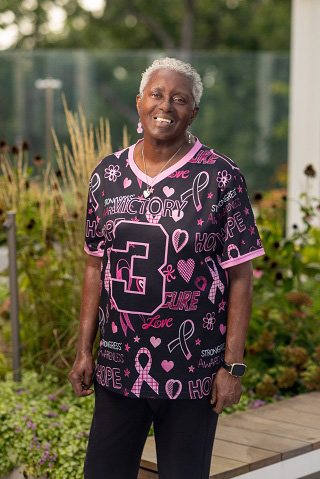 Still, there were difficult moments. Losing her hair was especially emotional, and she began wearing hats and turbans. But when she returned to work, the students she cared so deeply about continued to see her as the same person.
“My school community did a lot for me. I had to win this battle,” Mary said. “The students, they told me that I was strong, that they saw how hard I worked and that I’ve got this.”
Today, at 69, little by little, Mary is returning to the activities she enjoys. She spends time with a close group of friends who supported her throughout treatment, has begun getting back outdoors and has started chair yoga. This winter, she hopes to add swimming to her routine.
Mary is also learning that moving forward does not necessarily mean returning to exactly who she was before cancer. “I can’t do all the things that I used to do,” Mary said. “But I have to be patient with myself because of the things I can do. I thank God that I’m still here to be able to do anything.”
Her sister continues to be one of the most important people in her life and was an essential source of support throughout her cancer journey. “I couldn’t have done this without my sister or my brother-in-law” Mary adds.
Mary hopes her experience encourages other women to prioritize their health, even when fear makes it tempting to put off an appointment. Now, she knows that the reality of treatment was different from the frightening scenarios she had imagined before taking that first step. “The journey wasn’t easy, but it wasn’t as bad as I thought it was going to be,” she said. “I had created a scenario in my head.”
“Mary approached her treatment with tremendous strength and positivity, and what stands out most is her willingness to share the fear she felt before taking that first step,” says Dr. Raptis. “Once Mary came to us our entire team was committed to supporting her through every stage of her care.”
For Mary, that appointment ultimately opened the door to treatment, healing and a future she is deeply grateful to have. “It’s not a good thing to ever have cancer, but I have a great story,” says Mary. “I had so much support, so much encouragement, and so much care. I’m so grateful that I got another chance. A lot of good has come from it.”
Her message to other women is simple and comes directly from what she learned through her own experience: “Don’t be scared to get checked. Be scared not to get checked.”