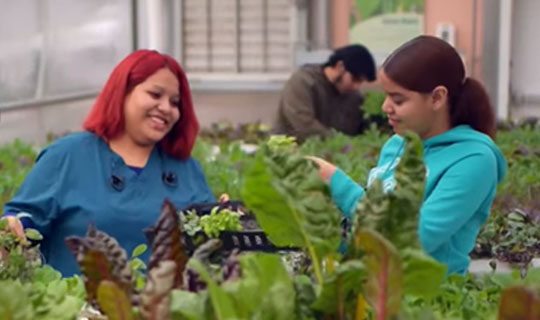
SNAP navigators help residents get nutrition assistance they need to live healthier lives.
Food insecurity impacts millions of families nationwide. People who are food insecure lack or have limited access to enough food or healthy nutrition. As a result, they have difficulty maintaining healthy lives.
Almost 1 million people in New Jersey, including more than 260,000 children, were food insecure in 2024, an increase of 22 percent over the previous year, according to an annual study by Feeding America, a hunger relief organization.
Reasons for limited availability of nutritionally sound foods often go beyond financial barriers to include complex social factors. In fact, access or lack of access to food is a critical social determinant of health—that is, a nonmedical factor that influences a person’s health and well-being.
RWJBarnabas Health (RWJBH) has long been committed to addressing food insecurity and enhancing access to food for low-income New Jersey residents. Examples of RWJBH efforts to address food insecurity include the Beth Greenhouse and Farmers Market at Newark Beth Israel Medical Center, Sadie Vickers Community Garden in South Toms River, the health system’s Food Farmacy Program and Common Market Farm to Pantry deliveries, among others.
Now RWJBH has launched an initiative in partnership with the New Jersey Department of Human Services’ Division of Family Development (DFD), with support from the New Jersey Food Security Initiative (NJFSI).
The initiative is the state’s first-of-its-kind program to embed Supplemental Nutrition Assistance Program (SNAP) navigators in all 12 RWJBH acute-care hospitals. SNAP provides low-income families with food assistance to help them buy groceries using a benefits card.
Piloting Through Process
“It’s a privilege to work with the DFD to help more people connect with SNAP, especially considering the strong connection between food and our health,” says Barbara Mintz, MS, RDN, Senior Vice President, Social Impact and Community Investment, RWJBH. “This program is important in addressing key drivers of food-related diseases, such as diabetes, obesity and heart disease, which can often be managed through diet and education. Food really is medicine.”
Hospital-based SNAP navigators can help eligible residents with processes such as SNAP applications, which Mintz says can be arduous. “We have a team of 12 highly trained navigators and two managers who help individuals apply for, enroll in and keep their SNAP benefits,” she says.
SNAP navigators answer questions, provide information and offer guidance about how SNAP works as well as eligibility requirements, documents needed when applying for benefits and more. They also assist with recertification when necessary.
Gabrielle Terry, a SNAP Navigator Program Manager, has seen the program’s impact firsthand. “Every day, our SNAP navigators meet people who were unsure where their next meal was coming from,” Terry says. “By guiding residents through the SNAP enrollment process and connecting them with local food resources, we’ve seen lives transform. Parents are able to provide nutritious meals for their children, and seniors can stretch their limited budgets further. It’s incredibly rewarding to witness how these small changes create a ripple effect of stability and health in our communities.”
Learn more about the SNAP Navigator Program at RWJBarnabas Health, or for information on SNAP navigators statewide, visit the New Jersey Department of Human Services' Snap Navigators page.
 View full issues of Healthy Together magazine by New Jersey region:
Northeast, serving the community of Jersey City Medical Center in Jersey City
Northwest, serving the communities of Clara Maass Medical Center in Belleville, Cooperman Barnabas Medical Center in Livingston, Newark Beth Israel Medical Center in Newark, Robert Wood Johnson University Hospital in Rahway, and Trinitas Regional Medical Center in Elizabeth
Central, serving the communities of Robert Wood Johnson University Hospital in Hamilton, New Brunswick and Somerset
South, serving the communities of Community Medical Center in Toms River, Monmouth Medical Center in Long Branch, and Monmouth Medical Center Southern Campus in Lakewood