“It can be a blessing to the person giving the kidney too. Studies have shown that people who donate live longer,”
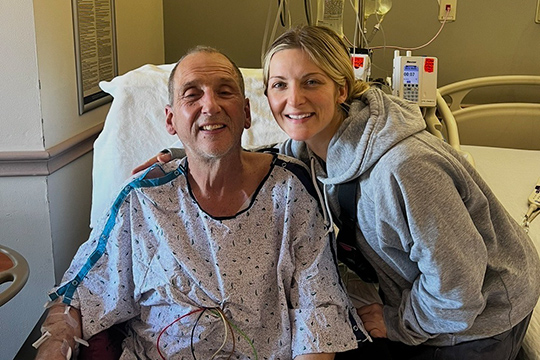
It was a “full-circle moment” when Elizabeth Bea first saw her father, Peter Cipot, exiting the operating room at Robert Wood Johnson University Hospital (RWJUH) after she had donated her kidney to him and his life-saving kidney transplantation surgery was complete. RWJUH is an RWJBarnabas Health facility.
“There was a moment seeing my dad when I thought - he gave me life and now I can help him lead a better, healthier life,” the 44-year-old Spring Lake resident said. “It was a full circle moment – the circle of life.”
Elizabeth and Peter’s kidney transplant journey began in 2023, when his kidneys began to fail after a decades-long battle with polycystic kidney disease (PKD).
According to the National Institutes of Health, PKD is a genetic disorder that causes many fluid-filled cysts to grow in the kidneys. It is a form of chronic kidney disease that reduces kidney function and may lead to kidney failure.
Peter, a retired CPA living in Highland Park, was diagnosed with PKD when he was 24. It runs in his family – his father, two sisters, both of his sons and a nephew all have been diagnosed with it.
After his diagnosis, Peter, now 68, followed his doctor’s recommendations to “live a moderate lifestyle” and eat healthy. About 10 years ago, doctors noticed a rise in his kidney’s creatinine levels.
“I started to notice a change in my early to mid-50s,” Peter explained. “I was just sluggish and I was slowly losing weight.”
His wife, Karen, became concerned when his weight dropped from a little over 200 pounds to 185.
“I had no real symptoms, I was retired, and I was working out more,” Peter recalled. “My wife noticed it (the weight loss) more than me.”
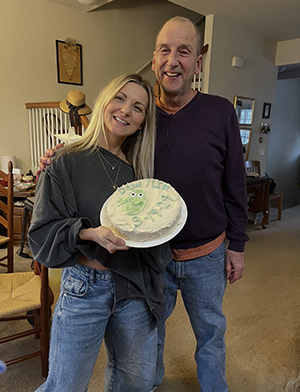 When Peter’s kidneys failed in 2023, he experienced more obvious symptoms such as chronic nausea. He was placed on dialysis for five months. Although he was listed for transplant, Peter was reluctant accept a living donor kidney, despite people offering to be tested to see if they were a match for him.
“I didn’t want to take someone’s kidney because I thought it may impact them physically, but I heard so many stories of how the donor gains so much joy and blessings from their selfless act, that I was willing to accept a donor kidney,” Peter said.
Peter didn’t know it at the time, but his daughter Liz was already being tested to see if she was a match. Her mom had connected her with Arlene McKnight, MSN, BSN, RN, the Living Donor Coordinator for RWJUH’s Kidney and Pancreas Transplant Program, to begin the six-month evaluation process. Liz was determined to help the man who raised her and had given her so much throughout her life.
“Even when I started the process, I told my mom to give me the information, but don’t tell dad,” Liz said.
Peter joked, “She went behind my back (to be tested) and was a match. I didn’t know a thing.”
According to Neeraj Singh, MD, MBA, FASN, FAST, Medical Director of RWJUH’s Kidney and Pancreas Transplant Program, a living donor kidney transplant offers patients the chance for better health, greater freedom, and improved long-term outcomes.

“Patients can avoid the time commitment and lifestyle restrictions associated with dialysis, thereby gaining greater independence in employment, travel, and daily activities,” Dr. Singh noted. “Patients can also avoid potential exposure to dialysis-related complications, such as infections, dialysis access-site complications, and cardiac strain, while preserving overall health and quality of life.”
When Liz finally learned that she was match, she thought about different ways to tell her father.
Finally, she said to him, “This isn’t just for you, this is for all of us. It’s for you to be better and to live longer. We love you and we want you here.”
Liz also shared her decision with her husband Ryan and daughters Mya and Ashley.
“They were all like, absolutely, do it!” Liz said. “Ryan also said, ‘I would expect nothing else from you.’”
On March 19, 2024, Liz gave her father the ultimate gift of life at RWJUH.
Peter is overwhelmed by his daughter’s kindness, but he wasn’t surprised by her choice.
“Liz is the greatest person – a unique person,” Peter explained. “We knew she would be a very successful, happy and generous person.”
For her part, Liz said she made her decision because of how Peter and Karen raised her.
“A lot of it has to do with our Catholic faith, which teaches to make yourself a servant to others,” Liz explained.
Now that he is enjoying an active lifestyle in his retirement with many visits to his grandchildren in Spring Lake and Philadelphia, Peter is an advocate for organ donation and transplantation – especially living donation.
“It can be a blessing to the person giving the kidney too. Studies have shown that people who donate live longer,” Peter said. “My recovery has been amazing and my kidney function has been great. It freed me from dialysis and it gave me life. I can live a normal life and not be tied to a machine.”
Learn more about living kidney donation at RWJUH's Kidney and Pancreas Transplant Center.