“God has been too good to me. He gave me the best doctors, the best nurses.”
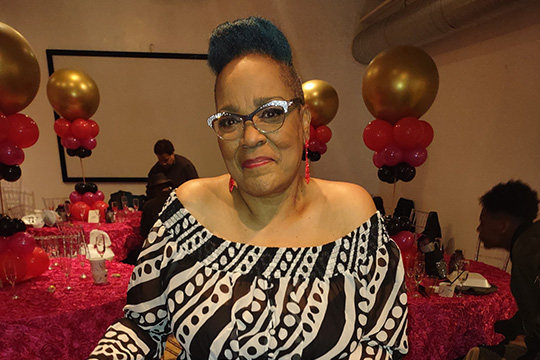
Pastor and Gospel Singer Returns to Active Life after Complex Robotic Surgery and Cancer Treatment at Robert Wood Johnson University Hospital and Rutgers Cancer Institute
Deborah Epps-Kinsey is a pastor and gospel singer who also enjoys painting, drawing and sometimes, acting and producing plays. She needed to lean on her faith and these passions for strength after she was diagnosed with an aggressive rectal cancer last year.
“With my creative side, you’re in a zone – it’s very therapeutic,” Deborah explains. “You see yourself whole. It would take me out of everything I was going through for a moment in time. It brings such a peace and I felt like I could do anything.”
Now, after a year-long fight that involved several weeks of radiation and chemotherapy to treat her cancer at Rutgers Cancer Institute and the Jack & Sheryl Morris Cancer Center followed by a complex 14-hour surgery at Robert Wood Johnson University Hospital (RWJUH), Deborah has made a full recovery and plans to get back to enjoying everything she loved to do before her illness.
“I have done a lot, but there is so much more for me to do,” Deborah says about her plans for the future. “God has been too good to me. He gave me the best doctors, the best nurses.”
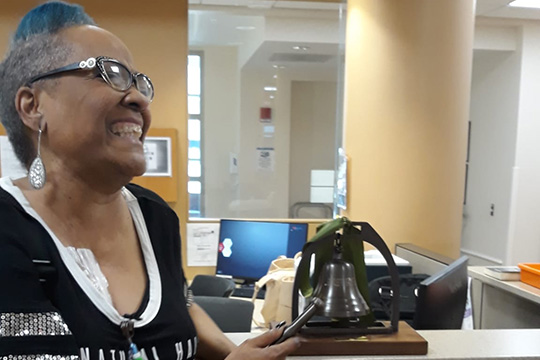
Deborah felt fine when she went for her annual check-up. Noting Deborah’s age (68) and that she never had a colonoscopy, her primary care physician recommended that she schedule one.
“It’s something that I would put off, because I was always very busy,” Deb explains. “The first exam showed a mass.”
The follow-up tests and biopsies revealed that Deborah had an aggressive, cancerous mass in her lower rectum that was invading her vagina. The shocking diagnosis didn’t sink in at first.
“I have a strong personality and can be rebellious,” Deborah says. “When you receive a diagnosis like that, it’s very hard to hear. I had a lot to say – I acted like I was five. I didn’t want to hear it.”
She was referred to Rutgers Cancer Institute and RWJUH where she met with Mariam Eskander, MD, MPH, Surgical Oncologist at Rutgers Cancer Institute and Brendan Scully, MD, a colorectal surgeon at RWJUH and Rutgers Cancer Institute.
Surgeons performed a biopsy that confirmed the mass was cancerous. Deborah then underwent five weeks of radiation therapy and six weeks of chemotherapy before surgeons could remove the mass.
“Generally, the plan is for the patient to undergo radiation therapy and chemotherapy first to shrink the mass then surgery to remove it,” Dr. Scully notes. “The mass was initially approximately 8 cm. The radiation and chemotherapy shrunk it significantly so it was more operable.”
Removing the mass was only the beginning of the steep challenge facing Deborah’s surgical team. The aggressive tumor caused structural damage to her rectal and vaginal areas, requiring complex reconstructive surgery.

The complexity of Deborah’s diagnosis required the expertise of highly skilled surgeons specializing in colorectal surgery, minimally invasive robotic surgery, gynecologic oncology and plastic and reconstructive surgery that can only be found at a major academic medical center like RWJUH and a National Cancer Institute (NCI)-designated cancer center such as Rutgers Cancer Institute.
Patients like Deborah also have access to expert colorectal and gynecologic oncologists from the Jack & Sheryl Morris Cancer Center on RWJUH’s academic medical campus in New Brunswick. The Morris Cancer Center is New Jersey’s only freestanding cancer hospital. Fully opened in September of 2025, the Jack & Sheryl Morris Cancer Center houses 88 state-of-the-art infusion chairs and 80 exam rooms for adults and pediatrics, as well as 96 private inpatient rooms, nine operating rooms, radiology, imaging resources in the building, four brand new linear accelerators (LINAC) including an MR-LINAC, a brachytherapy suite for radiation therapy delivery, and interventional radiology suites. Patients at the Jack & Sheryl Morris Cancer Center can benefit from the most advanced cancer treatments including clinical trials, cellular therapies, precision medicine, blood and marrow transplantation, complex surgical procedures and sophisticated radiation therapy techniques.
In December 2024, Deborah underwent a 14-hour, minimally invasive robotic operation at RWJUH performed by a multidisciplinary team of four surgeons that included Dr. Scully, Ruth Stephenson, DO, a gynecologic oncologist; Jeremy Sinkin, MD, a surgeon specializing in Plastic and Reconstructive Surgery; and Dylan Nieman, MD, PhD, FACS, who specializes in minimally invasive robotic surgery.
“Everyone works together as a team,” Dr. Scully explains.
Dr. Scully emphasizes that it’s not only the surgeons who are part of this team, but oncologists and radiologists. As a team, they review the patient’s anatomical structure, so surgeons can map the best and most accurate surgical approach and work together to develop the best treatment plan specific to a patient’s tumor, like Deborah’s. These meetings include a Tumor Board and the Colorectal Surgeons group that review complex cases.
First, Dr. Scully made 4-5 small incisions about half inch in length (as opposed to a 12-15 open incision needed for open surgery over the length of the abdomen) to remove part of the rectum and anus. Then, Dr. Stephenson performed a posterior vaginectomy to remove the cancerous mass – this left a hole in Deborah’s lower rectal area. Next, Dr. Niemann and Dr. Sinkin teamed up to reconstruct Deborah’s vaginal and rectal areas using an innovative technique to robotically create a rectus abdominus muscle flap.
“The most common way to reconstruct this area is to take skin and muscle from the abdominal wall by making a large incision spanning the entire abdomen, and then position the flap into the pelvis to reconstruct the vagina,” Dr. Sinkin explains.
Performing the procedure robotically and using the same small incisions made by Dr. Scully, Dr. Niemann harvested the flap tissue. Dr. Sinkin then completed the surgical reconstruction of Deborah’s vaginal and rectal areas. A mesh was also inserted robotically to reinforce her abdominal wall.
Following her surgery, Deborah returned home from the hospital after just five days.
“Robotic surgery allows patients like Deborah to return to the quality of life they had before and quickly,” Dr. Scully says. “I saw her two weeks post-op and she was walking around but limited. Two months post op, she was fully recovered and doing everything she did before.”
Deborah hopes to share her experience and support others facing similar challenges.
“There’s nothing I can’t do - God had my best interests at heart,” Deborah explains. “I had a lot of people praying for me. I said God, if there’s anything I can do to help someone who is where I was, help me do it.”
Get Checked! Early detection of colorectal cancer could save your life. Schedule your screening today.