“I’m so grateful to Dr. Kayiaros,” Cheryl says. “He’s an artist, and his staff is great, too. Having this surgery was the best decision I ever made.”

Cheryl Allen-Munley of Tewksbury never imagined she’d need a hip replacement, let alone two. Until 2022, the now-68-year-old retired engineer, who teaches math at a local college, had been vibrant and active—an avid horse rider who also loved to dance, walk, bike and do Zumba workouts.
During a summer visit to friends at the Shore with her partner, Jon, things started to turn. “During a mile walk back to their house, I felt something uncomfortable,” Cheryl recalls. After a moment’s rest on a bench, the discomfort went away.

Then in October she had a similar— but more painful—experience after a night of dancing. This time, the pain continued.
Cortisone shots from an orthopedist in January 2023 helped for only three days. By May, Cheryl found it hard to sleep and could barely walk without pain. She scheduled a hip replacement surgery for July.
Well-informed friends suggested that Cheryl have what they called an anterior procedure. Unsure how this approach differed from the traditional posterior surgery she’d booked, Cheryl did some research.
“I found that the posterior approach involved more cutting,” she says. She canceled her procedure and began looking for a new surgeon. “That’s when I found Dr. Kayiaros,” she says.
The Right Surgeon
Stephen Kayiaros, MD, Medical Director of the Joint Surgery Program at Robert Wood Johnson University Hospital Somerset, uses the anterior approach—a tissue-sparing technique that can lead to less pain, faster recovery and improved mobility—for more than 99 percent of his hip replacements.
He could plainly see the cause of Cheryl’s pain. “X-rays showed degeneration in her hips that was very advanced,” he says. “She had no cartilage left. It was bone-on-bone.”
A diagnosis of advanced osteoarthritis from ongoing wear and tear sometimes shocks people, Dr. Kayiaros says, especially when symptoms seem to develop quickly. “But arthritis doesn’t happen overnight,” he says. “It can go undetected for years. Then some event triggers an avalanche of symptoms. People may think the event caused the arthritis, but that’s rarely the case.”
Cheryl’s anatomy suggested she also may have been born with subtle hip dysplasia—a misalignment in the joint that can predispose people to arthritis later in life.
“I was now in terrible pain in both hips,” Cheryl says. She and Dr. Kayiaros decided she would have both hip joints replaced in one surgery.
Twice the Relief
The double procedure in December 2023 took less than two hours. With each hip joint, Dr. Kayiaros made a small, four-inch incision at the top of the upper thigh. Approaching the hip from the front (anterior) rather than the rear (posterior) allowed him to access the joint by navigating between muscles without cutting them.
In each hip, Dr. Kayiaros installed an implant made of materials such as titanium, medical-grade polyethylene and ceramic. Implants allow the joint to function smoothly, with certain surfaces roughened so bone more readily grows into them for strength and stability.
Cheryl was walking shortly after surgery. “I had no nausea, no grogginess, nothing,” she says. Normal post-op discomfort felt like nothing compared with her pain before the procedure.
“All I used for pain after surgery was Tylenol,” she says.
She used a walker for the first week of recovery, quickly progressing to a cane in the second. She was soon driving and teaching again.
“I have more mobility in my joints and a much longer stride than I did before,” Cheryl says. Exercise helped build strength and flexibility so she could swing onto a horse. By late 2024, she was riding again.
“I’m so grateful to Dr. Kayiaros,” Cheryl says. “He’s an artist, and his staff is great, too. Having this surgery was the best decision I ever made.”
Two Hips, One Surgery?
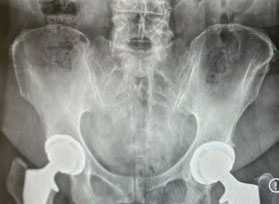 For patients who need both hips replaced, having them done at the same time can offer several benefits.
Known as simultaneous bilateral hip replacement, the procedure entails having anesthesia once rather than twice, and requires just one hospital stay and recovery. But it’s a longer surgery that can involve more blood loss and lengthier anesthesia.
“A good candidate generally has severe arthritis or degenerative changes in both joints that are equally debilitating; is younger than 75; has no significant medical comorbidities; and has no history of blood clots,” says Dr. Kayiaros.
Surgeons also evaluate potential candidates for lung problems, cardiovascular disease or other conditions that could increase the risks of complications during or after surgery.
“We consider each patient case by case,” says Dr. Kayiaros. “It’s a shared decision between doctor and patient.”
Award-Winning Orthopedic Care
For the second consecutive year, RWJBarnabas Health (RWJBH) has been named among the 100 Hospitals and Health Systems with Great Orthopedic Programs by Becker’s Hospital Review. The recognition honors orthopedic programs that:
- Deliver comprehensive, compassionate care for patients with musculoskeletal conditions and injuries
- Offer minimally invasive treatments
- Conduct forward-thinking research
- Perform breakthrough clinical trials that drastically improve patient outcomes
Programs on Becker’s list also have earned recognition from organizations such as U.S. News & World Report, Newsweek and Healthgrades; receive funding from organizations such as the National Institutes of Health; serve as official providers for elite sports teams; and hold the Gold Seal of Approval from The Joint Commission.
Learn more about orthopedic care at RWJBarnabas Health, or request an appointment.