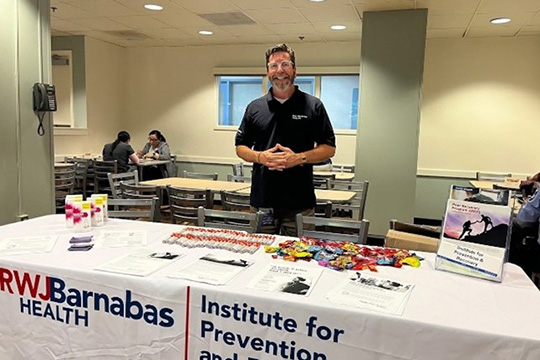
Patrick at the Recovery Month table RWJBarnabas Health’s Institute for Prevention & Recovery had this year at Trinitas Regional Medical Center.
At RWJBarnabas Health, we believe recovery isn’t just possible — it’s real. Two of our own from the Institute for Prevention and Recovery (IFPR), Amy F. and Patrick C., know this firsthand after dealing with their own addiction struggles a decade ago. Today, they’ve come full circle and are helping others forge their own paths to sobriety, recovery, and healing by being there when they need it most.
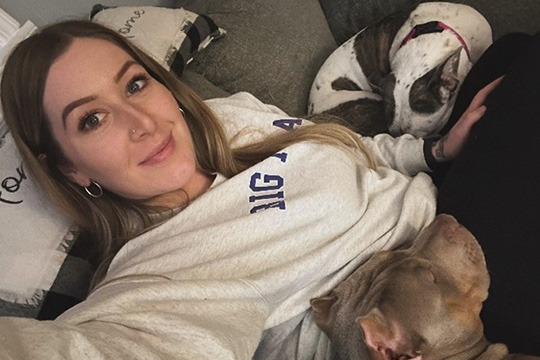
Struggling with Substance Use Disorder
Amy grew up around substance use and began experimenting at a young age. What started with pills and opioids quickly spiraled into stimulant use. “The first time I took OxyContin, I thought, ‘This is what I want to feel for the rest of my life,’” she says. But addiction nearly cost her everything. After stints in and out of rehab and surviving a near-fatal overdose, she knew she couldn’t let addiction keep controlling her life and wanted better for herself.
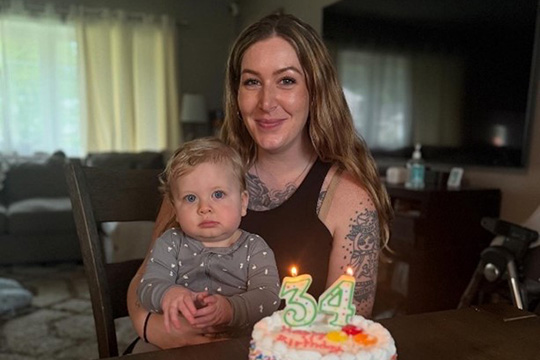
That was a decade ago. Today, she is a proud wife and mother to a one-year-old son.
“Addiction took everything from me, but recovery gave me everything back—and more,” she continues.“I never thought I’d be a mom, but my son is my biggest recovery gift.”
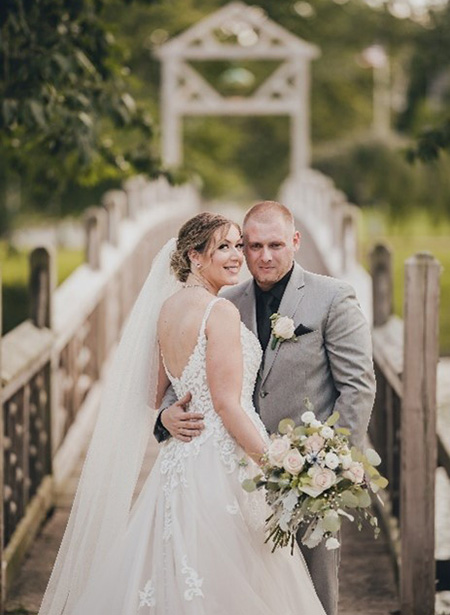
Patrick’s story looked different. He grew up in Florida and California, with divorced parents and a mother who struggled to care for her four sons due to mental illness, periods of family poverty, and frequent moves. Alcohol became a way for Patrick to cope with his personal and family struggles. Though he went to college and became a respected state court mediator, behind the scenes, alcohol was quietly consuming his life. “By 2014, I was drinking 24/7,” Patrick recalls. “I couldn’t stop, and I knew I was going to give up everything to my drinking.” After retiring from his job with the state, Patrick began building a new life — without alcohol.
Now, he is 11 years sober, a father, a public speaker, and an amateur photographer.
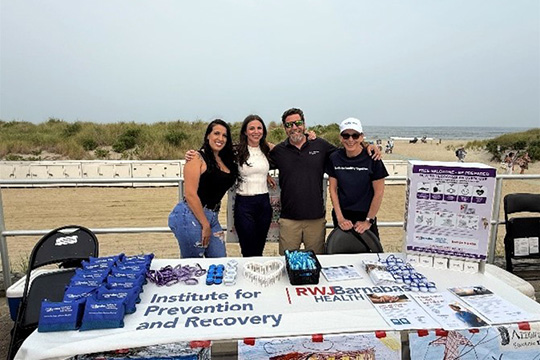
Patrick at RWJBarnabas Health’s Institute for Prevention & Recovery table at Bradley Beach National Night Out.
Turning Pain into Purpose
Today, Amy and Patrick help others who are struggling with similar situations. Amy works as a Supervisor at IFPR’s Peer Recovery Program, meeting patients at the bedside, offering compassion, support, and proof that recovery is possible. She listens to what may have led them to substance use and shares her story to show that recovery is possible.
“When I meet a patient after an overdose, I tell them, ‘I’ve been where you are. And I’m still here’”, she says.
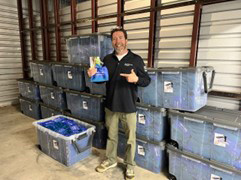
Patrick with the 15,000 care bags created as part of the RWJBarnabas Health Institute for Prevention & Recovery’s Naloxone Initiative.
Patrick serves as a Peer Recovery Program manager at Trinitas Medical Center and RWJUH Rahway, where he helped oversee RWJBarnabas Health’s Naloxone Distribution Kit Initiative earlier this summer. He and others from the Peer Recovery Program assembled 15,000 life-saving kits packed with opioid-overdose-reversal medication and essentials to protect patients and families after discharge. IFPR serves 20,000 patients annually across 12 RWJBarnabas Health hospitals in New Jersey.
“Naloxone is one of the easiest life-saving tools that exists,” he explains. “It gives people that little bit of space to still be with us—and maybe try again.”
Amy shares a similar sentiment: “I went from being a patient who needed naloxone to a supervisor who carries it to save lives. That’s full circle.”
Taking the First Step
Together, Amy and Patrick are proof that recovery is real and lasting. Their lives show that even in the darkest moments, change is possible.
“Recovery is possible,” Amy emphasizes. “Not just for me—but for anyone willing to try. We’re humans too. Where there is a heartbeat, there is a chance.”
If you or someone you love is struggling with substance use, know this: you are not alone, and recovery is possible.
“I’m living proof,” Patrick adds. “When I sit with someone in crisis, I don’t see their addiction. I see the person who can recover. If I can come back from where I was, anyone can.”
Call the RWJBarnabas Health Institute for Prevention and Recovery at 848-303-0008 for support and resources. More information can also be found at https://www.rwjbh.org/treatment-care/institute-for-prevention-and-recovery/.