“We needed a team of people working with us and CSH definitely provided that and knew what they were doing.”
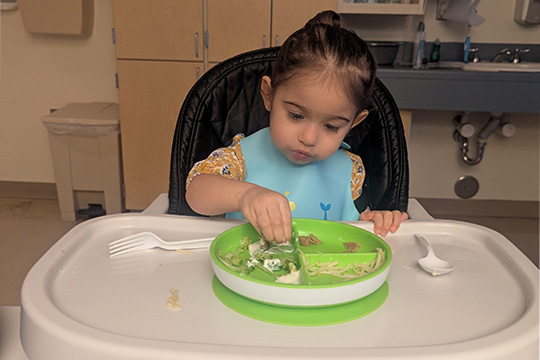
Robyn began her feeding therapy journey with Children’s Specialized Hospital when she was just a month old. When she was born, she weighed only 5 lbs. 10oz and struggled to gain weight. Despite her mom, Kendra’s best efforts to explore different feeding strategies. Robyn continued to lose weight and her pediatrician felt she required hospitalization and needed to receive a nasogastric tube (NG Tube) to ensure she was getting enough nutrients. After being hospitalized for two weeks, Robyn returned to CSH’s outpatient facility in Clifton, New Jersey to continue feeding therapy.
During her time at CSH, Robyn made progress with her therapists but eating continued to be a challenge. She struggled to eat by mouth, often vomited and developed indigestion. Robyn was dependent on her tube feedings and eating continued to be uncomfortable. After a couple months with her NG Tube, Robyn underwent surgery to receive a gastrostomy tube (G-Tube), which allowed for nutritional support through her stomach instead of her nose. This helped make eating a little more comfortable.
Inpatient Tube Weaning Program
Robyn worked with Speech-Language Pathologist Stephanie McCabe in Clifton who recommended Robyn’s family consider the new inpatient Tube Weaning Program at Children’s Specialized Hospital.
Robyn was accepted as the first patient in the program. By March 2026, Robyn was admitted to Children’s Specialized Hospital’s inpatient facility in New Brunswick to begin the Tube Weaning Program.
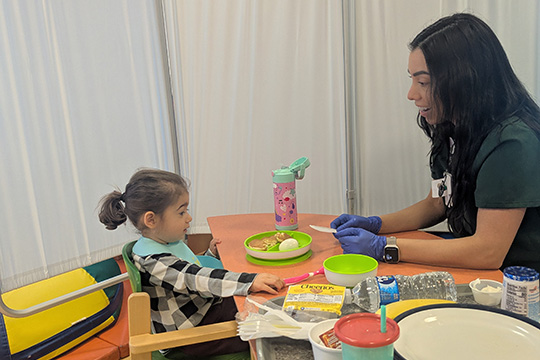
“Before Robyn was discharged, Stephanie was able to observe one of the sessions with Robyn’s inpatient team. It was good to see that Robyn’s inpatient and outpatient teams were all connected,” Kendra explained.
During her inpatient stay, Robyn’s schedule consisted of meals during feeding therapy with her occupational or speech therapist multiple times a day as well as play time and naps. In addition to working with her therapists, Robyn and her family were also supported by the 24-hour medical and nursing staff. “It helped to know that the nurses were checking on her, checking her weight every day, and just around if we needed them,” expressed Kendra. “We needed a team of people working with us and CSH definitely provided that and knew what they were doing.”
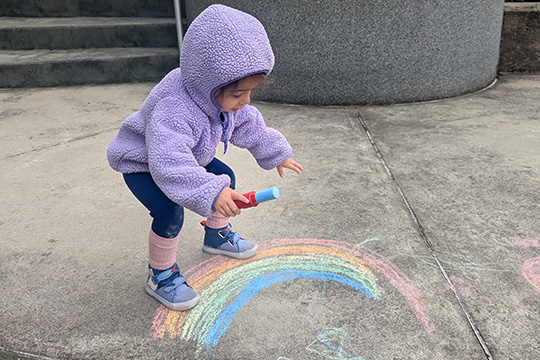
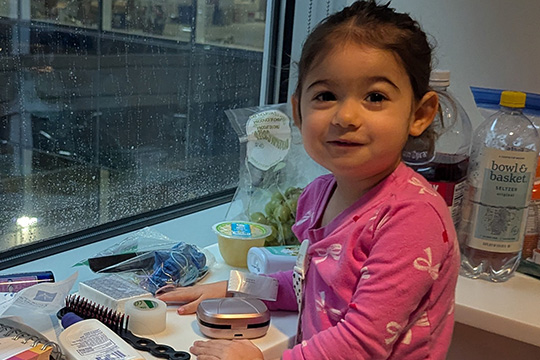
“When Robyn entered the Inpatient Feeding & Tube Weaning Program, her oral intake was very limited. Over just three weeks, we saw Robyn become more interested in food, recognize her hunger cues, begin self-feeding, and start to accept a greater variety of foods by mouth. Most importantly, the progress did not stop when she went home. Months later, Robyn was independently going into the kitchen to choose a snack. The program gave Robyn, and her family, the confidence and skills to move toward a positive relationship with food,” summarized Tennille Sterling, Director of the Inpatient Feeding & Tube Weaning Program.
Robyn was at Children’s Specialized Hospital’s inpatient facility for 3 weeks and since has continued to work with her outpatient CSH team in Clifton. She now meets with Stephanie every other week.
“Robyn made steady feeding progress during our time together and the Inpatient Feeding & Tube Weaning Program got her to that next level of independence,” explained Stephanie.
The Inpatient Feeding & Tube Weaning Program at Children’s Specialized Hospital is a 3-week acute inpatient rehabilitation admission focused on medically supervised tube weaning and intensive food therapy provided by speech pathology, occupational therapy, and psychology. The program is for children who have had a feeding tube for 6 months or more and have made minimal progress in outpatient feeding therapy. The program provides a structured approach that includes medical oversight, therapeutic feeding interventions, and psychosocial support to ensure a safe and effective transition from tube feeding to oral intake. “We use a multidisciplinary path from tube dependence to oral feeding – to give kids the opportunity to eat, grow, and thrive,” noted Tennille.