“I have no words to describe him,” Ana says of Dr. Sun. “He’s a very good doctor, but the way he cared for me and my family, he’s more than that – he’s a great person.”
Aneurysm Diagnosis and Neurosurgery at Robert Wood Johnson University Hospital Saves Local Waitress and Mother of Three
RWJBarnabas Health Celebrates Survivors during National Stroke Awareness Month
(New Brunswick, NJ) - Ana Mendez still remembers the jarring question Robert Wood Johnson University Hospital (RWJUH) and RWJBarnabas Health Neurosurgeon Hai Sun, MD, PhD, asked her last year after she was diagnosed with a brain aneurysm.
“Dr. Sun asked me to think about the impact of my condition on my family. He then went through what a brain aneurysm is and how it was affecting me. He also showed me I was at high risk of a devastating stroke if I didn’t have surgery,” Ana said. “I was outside my myself, I was scared. I cried every day.”
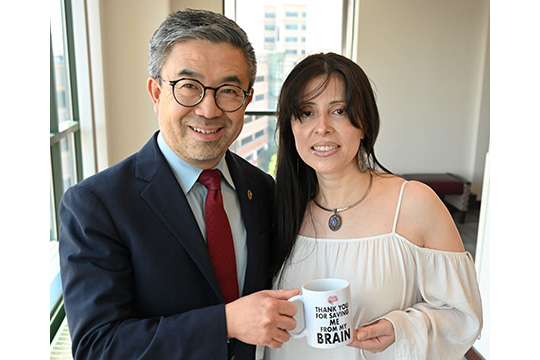
Shortly after her devastating diagnosis, Ana underwent life-saving brain aneurysm surgery at RWJUH. She is eternally grateful to Dr. Sun and his team at RWJUH and Rutgers Robert Wood Johnson Medical School (RWJMS). She expresses gratitude every chance she gets, whether it’s by designing a special mug for Dr. Sun that reads, “Thank you for saving me from my brain,” or writing a kind note on the dinner check after she waited on RWJMS Dean Amy Murtha, MD, and Keith Lewis, RPh, MD, Vice Dean at RWJMS.
“I have no words to describe him,” Ana says of Dr. Sun. “He’s a very good doctor, but the way he cared for me and my family, he’s more than that – he’s a great person.”

When Ana started having headaches in 2022, she thought it was due to the tremendous amount of stress she was under at work and at home. The single mother of two teenagers and a seven-year-old routinely worked 11–12-hour shifts as a waitress at a popular restaurant.
The headaches grew stronger and were more frequent. Ana started feeling intense pressure in her right eye.
“It (the eye) was blinking too much,” she explained. “My neck also started feeling stiff. I would take Tylenol and two or three Naproxens, but the headaches wouldn’t go away.”
In 2024, Ana’s symptoms worsened to the point where she found it difficult to speak during her headaches.
“I would become confused and couldn’t put my thoughts together,” she said.
The headaches grew unbearable on May 5, 2024. While trying to count the money in the register and the servers’ tips during closing, Ana lost her balance, couldn’t walk or talk and became nauseous. Counting the money was impossible – she could only count to three.
She was rushed to RWJUH’s Emergency Department, unable to walk or form clear sentences.
“The nurse was asking me questions and my head just felt so heavy, and my neck was weak,” Ana recalled. “I was trying to concentrate, but I started throwing up.”
While trying to determine the cause of her symptoms, doctors ordered CT and an MRI scan of her brain, which revealed a cranial aneurysm. The aneurysm did not rupture. She was discharged from the hospital and was referred to Dr. Sun for follow-up.
At first, Ana wasn’t diligent about scheduling her appointments with Dr. Sun, but his team was persistent.
“They kept calling. Saying, ‘Listen you have to come in for your appointments – Dr. Sun needs to talk to you personally,’” Ana said.
Dr. Sun rearranged his calendar so he could accommodate Ana’s work schedule to meet and review her treatment options.

While some aneurysms measuring 7 mm or lower can be monitored and do not require immediate medical intervention, Dr. Sun said that in some cases, if an aneurysm is left untreated, “there is a sizable risk of rupture.” He noted that it can lead to hemorrhagic stroke – a type of stroke during which a blood vessel breaks, leading to a potentially devastating intracranial brain bleed.
“One-third of the patients die before reaching the hospital or receiving any type of medical intervention,” Dr. Sun said. “Of the two-third who survive, half of them have permanent neurological damage and disabilities. Only one third experience a good outcome and regain independence.”
Ana underwent an eight-hour surgical clipping procedure to treat the aneurysm. Surgeons placed a clip at the base of Ana’s aneurysm. The clip effectively stops blood from entering the aneurysm, preventing it from growing and rupturing. Dr. Sun’s team also used intraoperative angiography to guide the clip’s placement at the base of the aneurysm to ensure the aneurysm is completely occluded and the parent artery of the aneurysm is fully protected.
“It is a long procedure, but using intraoperative angiography to confirm that the clip was placed correctly prevents surgical complications that may require bringing the patient back to the OR for the reposition of the clip, another invasive procedure requiring patient to be placed under general anesthesia,” Dr. Sun explained.
Ana’s surgery was successful, and according to Dr. Sun, her prognosis is “very good.”
“She has no obvious risk factors (for recurrence) such as smoking or high blood pressure,” Dr. Sun said. “Patients do very well and can return to their normal living after the recovery from the surgery if an aneurysm is treated before it ruptures.”
Headaches can have many causes, but when they become persistent and prevent normal activities and basic functioning, getting evaluated by a doctor can be critical. In Ana’s case, it was lifesaving. Terrible headaches are an important sign of stroke in the BE FAST acronym. The experts at RWJBarnabas Health urge everyone to know the signs of stroke and seek immediate medical help if a stroke is suspected.