“It was a no-brainer,” Brad says. “It was what we were searching for.”
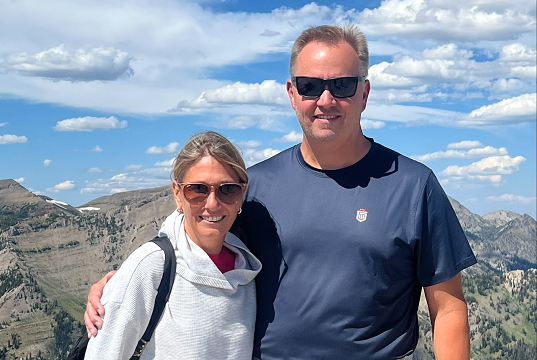
Married since 1997, Brenda and Brad Koehler have spent nearly three decades building a life together. When kidney disease became part of their journey, they faced it hand in hand.
With a family history of kidney disease, Brenda had been mindful of her kidney health. About two years ago, blood work following a spike in blood pressure led to a diagnosis of Alport syndrome, a genetic kidney condition.
At that time, Brenda’s kidney function was still relatively stable, and she focused on managing her health through diet and close monitoring. However, she didn’t expect how quickly things would change.
Over the next year, Brenda’s kidney numbers began to decline more rapidly. As her condition progressed, her nephrologist began discussing long-term treatment options, including the possibility of a kidney transplant.
When deciding where to pursue kidney transplant care, Brenda’s nephrologist recommended Cooperman Barnabas Medical Center, citing the strength and experience of its transplant program.
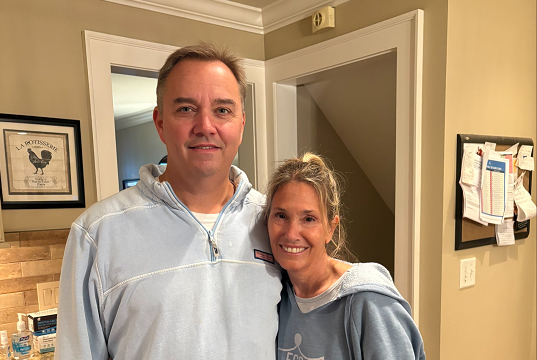
As Brenda and Brad further researched the Renal and Pancreas Transplant Division at Cooperman Barnabas Medical Center, they were impressed by the high transplant volume, strong outcomes, and comprehensive approach to care. Living in Chatham, the ability to receive this high level of care close to home made the process seem even more manageable.
After meeting the kidney transplant team at Cooperman Barnabas Medical Center, the decision became clear to the couple. “It was a no-brainer,” Brad says. “It was what we were searching for.”
Initially, Brenda explored whether her sibling or half-sibling could be her living-donor, believing a genetic match might offer the best chance. For health reasons, neither option was possible. Brad immediately asked to be considered as a donor, though the couple assumed chance of a match were slim.
Together, Brenda and Brad started to learn more about their options, including kidney paired donation, understanding that even if Brad could not donate directly to Brenda, his donation could still help her receive a kidney.
To their surprise, the testing showed that Brad was actually a strong match and they were compatible. With that news, they moved forward with plans for transplant.
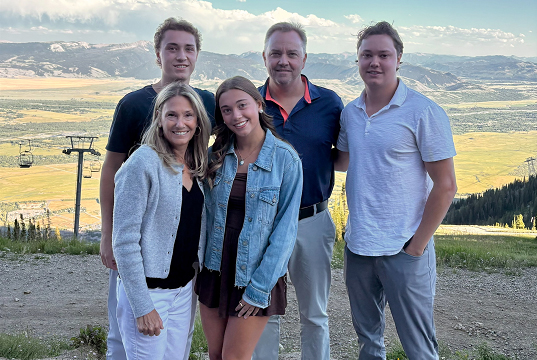
“Living donation is one of the most generous acts a person can make,” shares Praveen Kandula, MD, medical director of the Living Donor Institute at Cooperman Barnabas Medical Center. “Our role is to ensure donors are fully informed, medically safe, and supported every step of the way, while helping recipients regain their health and independence.”
During one of Brenda’s transplant workup appointments, imaging revealed a growth on her left kidney that raised concern for cancer. At this point, she underwent surgery to remove the kidney. While the growth turned out to be benign, the surgery required her to start dialysis. She remained on dialysis while Brad completed the living-donor evaluation process.
“Sometimes transplant journeys don’t always follow a straight line. What matters is having an experienced team that adapts, communicates clearly, and keeps patients moving forward, even when unexpected challenges arise,” says Dr. Kandula.
Eventually, Brad and Brenda were cleared for surgery, the transplant proceeded, and was successful.
In particular, communication and optimism were the two things that stood out to the Koehler’s throughout their kidney transplantation process.
“There was never a gap in communication. Everything was explained, whether it was why something was happening or what the next step would be,” shares Brad. “There was also always optimism,” he added. “If something didn’t go as planned, it was here’s how we deal with it and move forward. That reassurance made a huge difference.”
Brenda agreed. “Often I would arrive at appointments feeling nervous, but I always left feeling encouraged about the future,” she shared.
While Brad was able to return to work and resumed his normal routine just a week after surgery, Brenda’s recovery marked something deeper. It symbolized the return of hope, especially after experiencing a short time on dialysis and having three children in their college years.
“For a while it was hard to think about what came next, but now conversations about the future feel possible again. We can both look and plan ahead again,” shares Brenda. “I’m feeling wonderful. My numbers have been great, and I feel incredibly fortunate.”
“With living donor transplantation, it often allows patients to avoid or limit time on dialysis and return to a more normal life sooner,” shares Dr. Kandula. “Seeing that renewed sense of hope in patients like Brenda is why this work is so meaningful.”
About The Renal and Pancreas Transplant Division at Cooperman Barnabas Medical Center
The Renal and Pancreas Transplant Division, located in Livingston, NJ, is one of the leading kidney transplant centers in the country. The Transplant Division at Cooperman Barnabas Medical Center offers compassionate and comprehensive transplant care for adult and pediatric kidney patients.
The Living Donor Institute at Cooperman Barnabas Medical Center offers an increasing number of innovative living donation techniques available at only a few of the world’s leading transplant centers.
With a patient-centered approach, we aim to provide a caring environment with state-of-the-art diagnostic and treatment capabilities. Our multidisciplinary transplant team guides patients through the process of deciding on kidney transplant as a treatment option, understanding transplantation, finding a donor, and maintaining a healthy organ after transplant.