“Gene was the biggest advocate for his care and his health,” Dr. Eltoukhy says, reflecting on memories of him as his patient. “He trusted me fully to guide him in his diagnosis and how we treat it and took everything he was supposed to do very seriously.”
From Rare Blood Cancer
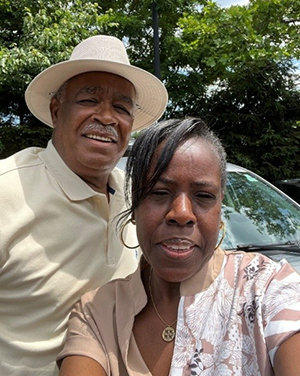
At 71, Gene Richardson was a brick mason who was used to staying busy, but that all changed in late 2023, when he passed out at work.
“He collapsed on the job because his blood count was so low,” recalls his caregiver, Thomasina. “His hemoglobin was around five. We knew something was very wrong.”
And then came the diagnosis: Gene had high-risk myelodysplastic syndrome (MDS), a rare and aggressive blood cancer where immature blood cells in the bone marrow fail to become healthy blood cells.
“There’s no staging system for MDS in the standard sense,” explains Hussam Eltoukhy, MD, a blood cancer specialist who treated Gene at Monmouth Medical Center (MMC). “But we classify it by risk factors that describe how aggressive the disease is and its tendency to transform into acute leukemia. High-risk MDS is considered a rare and aggressive blood disorder.”
MDS can progress to acute myeloid leukemia (AML) in roughly a third of MDS cases, with the risk being higher for those who have a higher-risk form of MDS, such as Gene.
MDS Treatment, Followed by a Bone Marrow Transplant
 Gene began treatment with an oral medication, but it wasn’t effective at controlling his MDS the way doctors had hoped. He was switched to an injectable treatment known as a subcutaneous hypomethylating agent after that, which lowered his blood count, leaving him susceptible to serious infections like UTIs that often require hospitalization.
For the next year and a half, Gene underwent treatment for his MDS at MMC before being referred for the critical next step: an allogeneic bone marrow transplant at Rutgers Cancer Institute in February 2024. Fortunately, Gene’s son was a match for the transplant. An allogeneic bone marrow transplant is a procedure in which tissue, in this case bone marrow, closely matches the patient, such as a child, sibling, or parent. Currently, allogeneic bone marrow transplant is the only known curative therapy, as it replaces the damaged hematopoietic (blood-forming) system with healthy donor stem cells, effectively curing MDS. This is because MDS affects the bone marrow’s ability to produce healthy blood cells, which causes low blood counts.
Rutgers Cancer Institute was recognized in 2018 as a Center of Excellence by the Myelodysplastic Syndromes (MDS) Foundation for its research, diagnosis, and treatment of MDS.
The Kind of Patient Who Drives His Own Recovery
After receiving his bone marrow transplant, Gene steadily moved toward recovery. He remained on protective and immunosuppressive medications, gradually tapering down this year to just one pill taken twice a day.
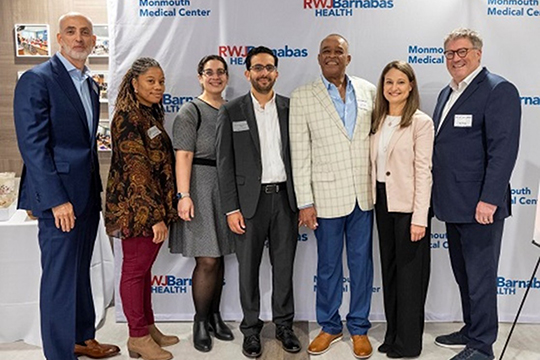
In June, Gene had the honor of joining MMC hospital and oncology leadership for the Long Branch Light the Night Leadership Launch event, where community members gathered to learn about the Leukemia and Lymphoma Society and one of their most powerful programs, Light the Night.
“Gene was the biggest advocate for his care and his health,” Dr. Eltoukhy says, reflecting on memories of him as his patient. “He trusted me fully to guide him in his diagnosis and how we treat it and took everything he was supposed to do very seriously.”
What Gene’s Outcome Says About Blood Cancer Care at MMC
Patient outcomes like Gene’s are part of the reason why Monmouth Medical Center received High Performing recognition for excellence in treating leukemia, lymphoma, and myeloma in the 2025-2026 edition of U.S. News & World Report Best Hospitals. Monmouth Medical Center, together with Rutgers Cancer Institute, New Jersey’s only National Cancer Institute-designated Comprehensive Cancer Center, provides patients access to the most advanced treatment options, including bone marrow transplant, cellular therapies, and clinical trials.
“Gene’s outcome is a testament to world-class, evidence-based care that is provided for blood cancer patients at MMC together with Rutgers Cancer Institute,” Dr. Eltoukhy says. “He’s been doing so well, he decided to move back home to Alabama, where he has been taking care of his horse and farm animals. He’s been so grateful and says he hasn’t felt this great in years.”
For Thomasina, the biggest takeaway is simpler: Gene has his life back. “He made it through,” she says. “And he’s doing wonderfully.”