No, Your Cardiologist Doesn’t Recommend Jumping From Planes…Unless You’re Larry Thomas
RWJBarnabas Health Heart and Vascular Network of Care Gets 82-Year-Old, Guinness Record- Holding, Skydiver Back in the Air
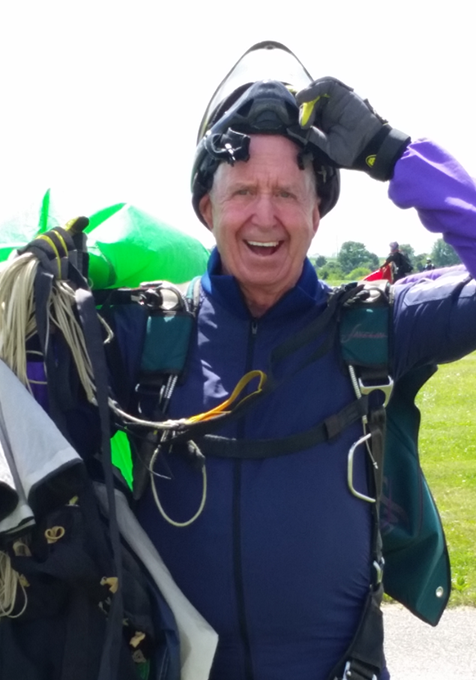
At 82, Larry Thomas is a self-described “adrenaline junkie” who skydives, skis, cycles and has raced cars. A retired mathematics teacher, Larry has completed more than 4,200 skydives, organized a Guinness World Record jump with 35 skydivers age 70 and older, and was the oldest skydiver to take part in a 100-way jump in California.
“If your sport can’t kill you, then it’s only a hobby,” Larry jokes about his love of skydiving.
Larry didn’t start skydiving until age 53, after his racquet ball buddy, Dave Benjamin, kept asking him to jump with him.
“For two months, he kept after me to come with him and a do a tandem jump,” Larry recalls. “Finally, I went just to shut him up. It scared me to death at first – I closed my eyes when I jumped. When I finally opened them, I looked around and said to myself, this is pretty cool.”
Nearly three decades later, Larry was still going strong when his heart threatened to ground him.
In 2018, Larry became lightheaded and short of breath while warming up for a racquetball match. He was concerned enough to make an appointment with his primary care physician who referred him to Rachana Kulkarni, MD, FACC, MBA, CPE, at Medicor Cardiology. Dr. Kulkarni is Regional Director of Cardiovascular Services for RWJBarnabas Health and a member of the RWJBarnabas Health Medical Group.
Based on Larry’s symptoms, Dr. Kulkarni ordered a nuclear stress test to identify any blockages in his arteries impeding the blood flow to his heart.
“The stress test revealed that the front part of his heart was not getting enough blood supply, which indicated a significant coronary blockage,” Dr. Kulkarni explains. “I recommended a cardiac catheterization, which indeed showed an 85 percent blockage in his left anterior descending coronary artery.”
Larry underwent an angioplasty and stent placement procedure in the artery to restore proper blood flow to his heart. He felt healthy again and continued skydiving, skiing and even added pickle ball to his impressive list of activities.

In 2023, Larry began to have irregular heartbeats and was diagnosed with peroxyl atrial fibrillation. A different cardiologist prescribed blood thinners, which would likely put an end to Larry’s skydiving and he was reluctant to take them.
“Dr. Kulkarni told me that if I injured myself while skydiving, I could bleed out,” Larry explains. “But if I couldn’t continue with what I was doing, I would shrivel up in a ball and blow away in the wind.”
Larry was at a crossroads. Throttling down his active lifestyle wasn’t an option, but Larry’s atrial fibrillation still needed to be addressed.
“Without the blood thinners, Larry was at risk of having a stroke,” Dr. Kulkarni explained. “That would be devastating so we decided to take a systematic approach to provide him with an acceptable solution.”
After additional testing, Dr. Kulkarni and Larry discussed his treatment options. They settled on the Watchman device. The Watchman is a plug that seals off the heart’s left atrial appendage - the main source of stroke-inducing blood clots - preventing the clots from travelling to the brain. It was implanted by Dr. Kulkarni’s Medicor colleague, Sanjukta Sanyal, MD, FACC, FHRS, in the Cardiac Catheterization Laboratory at RWJUH New Brunswick.
“Within three to six months, we were able to take Larry off blood thinners,” Dr. Kulkarni explained. “After a few weeks, we performed a TEE (transesophageal echocardiogram) to make sure the device was implanted properly with no leakage. We repeated the test three months later and it was still working well.”
Dr. Kulkarni believes the collaboration between RWJBarnabas Health Heart and Vascular network of care providers at RWJUH New Brunswick and Somerset played a key role in Larry’s successful outcome. Larry’s cardiac catheterizations, stenting and TEE follow-up procedures were completed at RWJUH Somerset, while the Watchman device was implanted at RWJUH New Brunswick.
“This is a perfect example of how both campuses functioned as one hospital to ensure the best, seamless care for our patient,” Dr. Kulkarni notes.
For Larry, the Watchman device meant freedom to keep doing what he’s loved since childhood. Larry says that “sports have been my world since I was four.” In addition to skydiving, he played Division I college basketball at Rider University, is a ski racer who can ski up to 70 miles per hour and has raced cars in the Poconos.
“Dr. Kulkarni is fabulous. Her primary interest was in me - she said that my lifestyle is unbelievable and she wanted to do everything that she possibly could to keep it going,” Larry says. “I plan to keep doing these things as long as I am vertical. Thank God I found Dr. Kulkarni so I can continue this wonderful lifestyle I’ve had since I was a teenager.”
Learn more about Heart and Vascular Care at RWJUH New Brunswick.