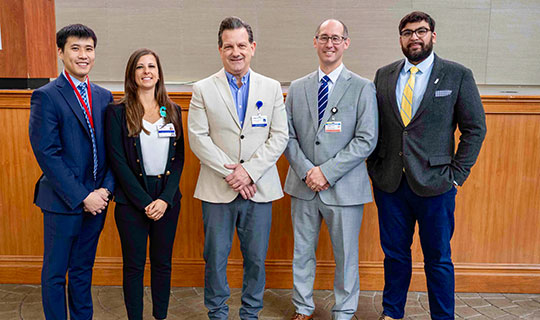
The pediatric urology team at RWJBarnabas Health, from left: Wayland J. Wu, MD, Kara McAbee, MD, Joseph G. Barone, MD, Charles W. Concodora, MD, and Haris S. Ahmed, MD
At RWJBarnabas Health (RWJBH), improving Children’s Health throughout the region is an important priority. The goal of the Children’s Health service line is to align the system’s vast clinical resources to ensure we deliver the very best outcomes and provide the safest, highest quality care, wrapped in an exceptional experience that allows children and families to heal emotionally.
First Things First
The last year has seen a massive investment leading to the establishment of a system wide pediatric quality and safety program. The program brings together all our children’s programs and aligns them with the nationally accepted standards for children’s Q + S programs. This includes Solutions for Patient Safety (SPS), the American College of Surgeons, National Surgical Quality Improvement Program Pediatrics (NSQiP-Ped), and Society of Thoracic Surgeons (STS) for peds cardiac surgery, with others following. The creation of this program and a system-wide balanced score card will allow us to benchmark our performance, learn, and continue our system’s journey towards “zero harm” for our patients.
Managing Complex Conditions
The increasing complexity of children requiring hospital admission requires a multidisciplinary team approach and bringing to bear the most advanced science and technology. Embracing a service-line approach facilitates bringing together the collective and formidable resources of our health system so that we can increase our capabilities and develop best-in-class programs. Examples of this evolution include:
- The growth of our Pediatric Stem Cell Transplantation and Cellular Therapies Program at Rutgers Cancer Institute and The Bristol-Myers Squibb Children’s Hospital at Robert Wood Johnson University Hospital, led by Nikita Shah, MD, who joined us from Yale. This past year, five patients received an allogenic transplant (four were sickle cell patients), one patient received CAR T-cell therapy, and one patient received gene therapy for sickle cell. To date, all sickle cell patients are sickle cell disease-free and continue to be monitored.
- Development of specialized GI programs in celiac disease and eosinophilic esophagitis.
- Recent work being done by our NICU teams to bring the most advanced renal replacement technology to our smallest and most vulnerable patients.
Charting Our Future
This year also saw our first pediatric service line retreat. This daylong event brought together the highest levels of leadership from RWJBH, Rutgers School of Medicine, faculty and providers along with outside experts in pediatric healthcare strategy and in pediatric healthcare delivery platforms to discuss the evolving pediatric healthcare landscape and discuss how we will adapt and grow.
We highlight how our evolving programs are impacting complex individual patients today and how we are enhancing our transportation services to ensure we can rapidly respond and provided the safest and most advanced transportation services to our children.