Study published in NEJM AI evaluated more than 23,000 high-risk patients across 11 RWJBarnabas Health hospitals
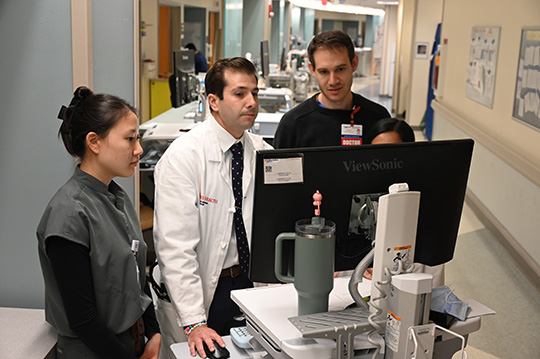
Dr. Nahass collaborates with clinical staff at Robert Wood Johnson University Hospital, an RWJBarnabas Health facility, while reviewing patient data in the electronic health record.
West Orange, N.J., July 23, 2026 – Researchers from RWJBarnabas Health and Rutgers Robert Wood Johnson Medical School found that an artificial intelligence (AI)-enabled early warning system helped identify hospitalized patients at risk of rapid clinical decline sooner, contributing to fewer deaths among high-risk patients.
Published in NEJM AI, a journal from the New England Journal of Medicine group (DOI: 10.1056/AIoa2500973), the study evaluated outcomes among 23,132 high-risk patients across 11 RWJBarnabas Health hospitals. Deaths among high-risk patients fell from 23.1 percent to 18.6 percent following implementation of the AI-enabled early warning system, representing an 18 percent reduction in the risk-adjusted odds of in-hospital death.
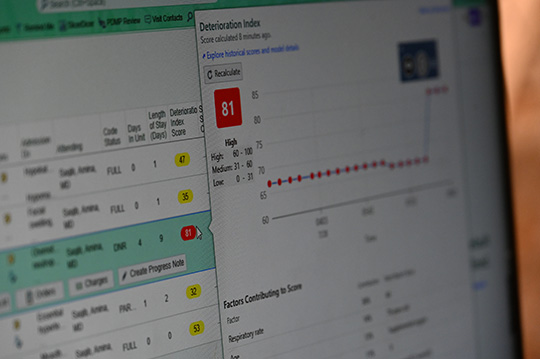
The AI-powered deterioration index displays a patient's risk score, helping clinicians at Robert Wood Johnson University Hospital, an RWJBarnabas Health facility, recognize signs of deterioration earlier.
Hospitalized patients can deteriorate quickly, often before obvious warning signs become apparent. Researchers evaluated the Epic Deterioration Index (EDI), an AI-enabled tool that continuously analyzes information already captured in the electronic health record, including vital signs, laboratory results, nursing assessments and age, to identify patients at increased risk of serious clinical decline. The system recalculates risk scores every 15 minutes and automatically alerts rapid response teams when patients reach the highest-risk category.
Before evaluating the technology in this study, RWJBarnabas Health and Rutgers spent several years developing and implementing a systemwide approach to using the EDI across its hospitals. The health system first integrated the tool into its electronic health record at its academic medical center, Robert Wood Johnson University Hospital, to pilot and refine it, including, how and when alerts were delivered, established automatic notifications to rapid response teams, trained clinicians on its use and continuously monitored its performance. Researchers from Rutgers then partnered with RWJBarnabas Health to evaluate the impact of this approach in real world clinical practice and rapidly rolled out the platform to the other 10 hospitals.
“Our goal was to identify patients earlier, before they reached a point where intervention becomes much more difficult,” said Thomas Nahass, MD, VP of Health Informatics and intensive care physician at RWJBarnabas Health, and Assistant Professor of Medicine at Rutgers Robert Wood Johnson Medical School and lead author of the study. “The deterioration index gives us an earlier point in time. If we can get a critical care eye on the patient sooner, we can change the course of their outcome.”
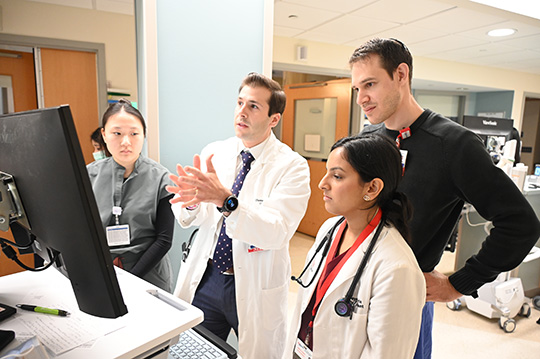
Dr. Nahass leads a discussion with members of the clinical care team at Robert Wood Johnson University Hospital, an RWJBarnabas Health facility, while reviewing the AI-powered deterioration index within the electronic health record.
When patients reached the highest-risk threshold, automated notifications were sent directly to hospital rapid response teams, enabling critical care specialists to quickly assess patients and determine whether additional interventions were needed. Following implementation, rapid response team activations among high-risk patients increased from 25.3 percent of hospital stays to 37.5 percent.
The study evaluated outcomes among high-risk adult patients receiving care at academic medical centers, community teaching hospitals and community hospitals throughout the RWJBarnabas Health system. Despite the increase in rapid response evaluations, transfers to intensive care units did not significantly increase, while mortality rates declined substantially.
“Every minute matters when a patient’s condition begins to worsen,” said Andy Anderson, MD, Chief Medical and Quality Officer, RWJBarnabas Health and study co-author. “This study demonstrates how AI-enabled tools, when paired with experienced clinical teams can help us identify patients at risk sooner and deliver the right care at the right time. These findings highlight the potential for innovation to improve quality, safety and outcomes for the patients we serve.”
“This is what an integrated academic health system is for,” said Stephen P. O'Mahony, MD, FACP, Senior Vice President and Chief Medical Information Officer at RWJBarnabas Health and senior author of the study. “We combined Rutgers methodological rigor with the operational reach of 11 RWJBarnabas hospitals. The mortality benefit was not produced by an algorithm but by the partnership around the algorithm.”
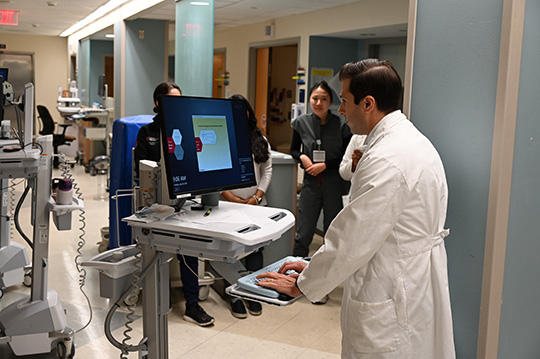
Dr. Nahass reviews the AI-powered deterioration index within the electronic health record at Robert Wood Johnson University Hospital, an RWJBarnabas Health facility.
Researchers note that the mortality benefit likely resulted from a combination of factors, including staff education, enhanced clinical awareness, electronic health record alerts and automated rapid response team notifications working together as a coordinated systemwide approach. Because the study evaluated the Epic Deterioration Index, a tool already available within Epic, one of the nation's most widely used electronic health record systems, the findings may have implications for hospitals nationwide seeking to improve patient outcomes. Researchers are now evaluating the next phase of the initiative, which focuses on identifying patients whose risk scores are rising rapidly in hopes of enabling even earlier intervention.
Along with Drs. Nahass and O’Mahony and, authors include: Co-first author Joseph S. Hanna, MD, Rutgers Robert Wood Johnson Medical School and Robert Wood Johnson University Hospital; Nancy Liu, MPH, and Jason Roy, PhD, Rutgers School of Public Health; Nicole Martinez, RWJBarnabas Health; Ethan A. Halm, MD, MPH, MDA, Rutgers Robert Wood Johnson Medical School; Amy Rockman, Rutgers Biomedical and Health Sciences; Christopher Gilligan, MD, MBA, Robert Wood Johnson University Hospital; Amy P. Murtha, MD, Rutgers Robert Wood Johnson Medical School and Vicente Gracias, MD, MD, FACS, FCCP, FCCM, Rutgers Biomedical and Health Sciences.
About RWJBarnabas Health
RWJBarnabas Health is New Jersey’s largest and most comprehensive academic health system, caring for more than five million people annually. Nationally renowned for quality and safety, the system includes 14 hospitals and 9,000 affiliated physicians integrated to provide care at more than 700 patient care locations.
RWJBarnabas Health partners with its communities to build and sustain a healthier New Jersey. It provides patient-centered care in a compassionate manner and is the state’s largest safety-net provider and leader in addressing the social determinants of health. RWJBarnabas Health provides food to the hungry, housing for the homeless and economic opportunities to those most vulnerable.
RWJBarnabas Health’s commitment to enhancing access to care includes a transformative partnership with Rutgers University, including Rutgers Cancer Institute — the state's only NCI-designated Comprehensive Cancer Center, and Rutgers Robert Wood Johnson Medical School.
RWJBarnabas Health is among New Jersey’s largest private employers, with more than 45,000 employees, contributing more than $7 billion to the state economy every year. For more information, visit www.RWJBH.org.
About Rutgers Robert Wood Johnson Medical School
As one of the nation’s leading comprehensive medical schools, Robert Wood Johnson Medical School is dedicated to the pursuit of excellence in education, research, health care delivery, and the promotion of community health. Part of Rutgers, The State University of New Jersey, Robert Wood Johnson Medical School encompasses 20 basic science and clinical departments, and hosts centers and institutes including The Cardiovascular Institute, the Child Health Institute of New Jersey, the Institute for Neurological Therapeutics, and the Women’s Health Institute.
The medical school has been recognized by U.S. News & World Report as among the top 100 medical schools in the nation and No. 1 in the state for research and primary care. Robert Wood Johnson Medical School and Robert Wood Johnson University Hospital, an RWJBarnabas Health facility and the medical school’s principal affiliate, comprise one of the nation’s premier academic medical centers. Clinical services are provided by more than 500 faculty physicians in 200+ specialties and subspecialties as part of Rutgers Health and the RWJBarnabas Health Medical Group.
To learn more about Rutgers Robert Wood Johnson Medical School, visit rwjms.rutgers.edu.
Contact: Carrie Cristello
Carrie.Cristello@rwjbh.org